
Visual Travel Guide

Bhutan Travel Guide in Infographics

Visas, fees, flight routes, weather, and safety — everything you need to plan a trip to Bhutan, distilled into nine shareable infographics

Planning a trip to Bhutan involves a few rules you won't find anywhere else — a nightly Sustainable Development Fee, a mandatory licensed guide, and flights that only a handful of airlines operate. Our team at Byways put the essentials into these infographics so you can understand the whole system at a glance, save them for offline reference, or share them with your travel companions. Each one links to a full written guide if you want the detail.

Planning Your Trip

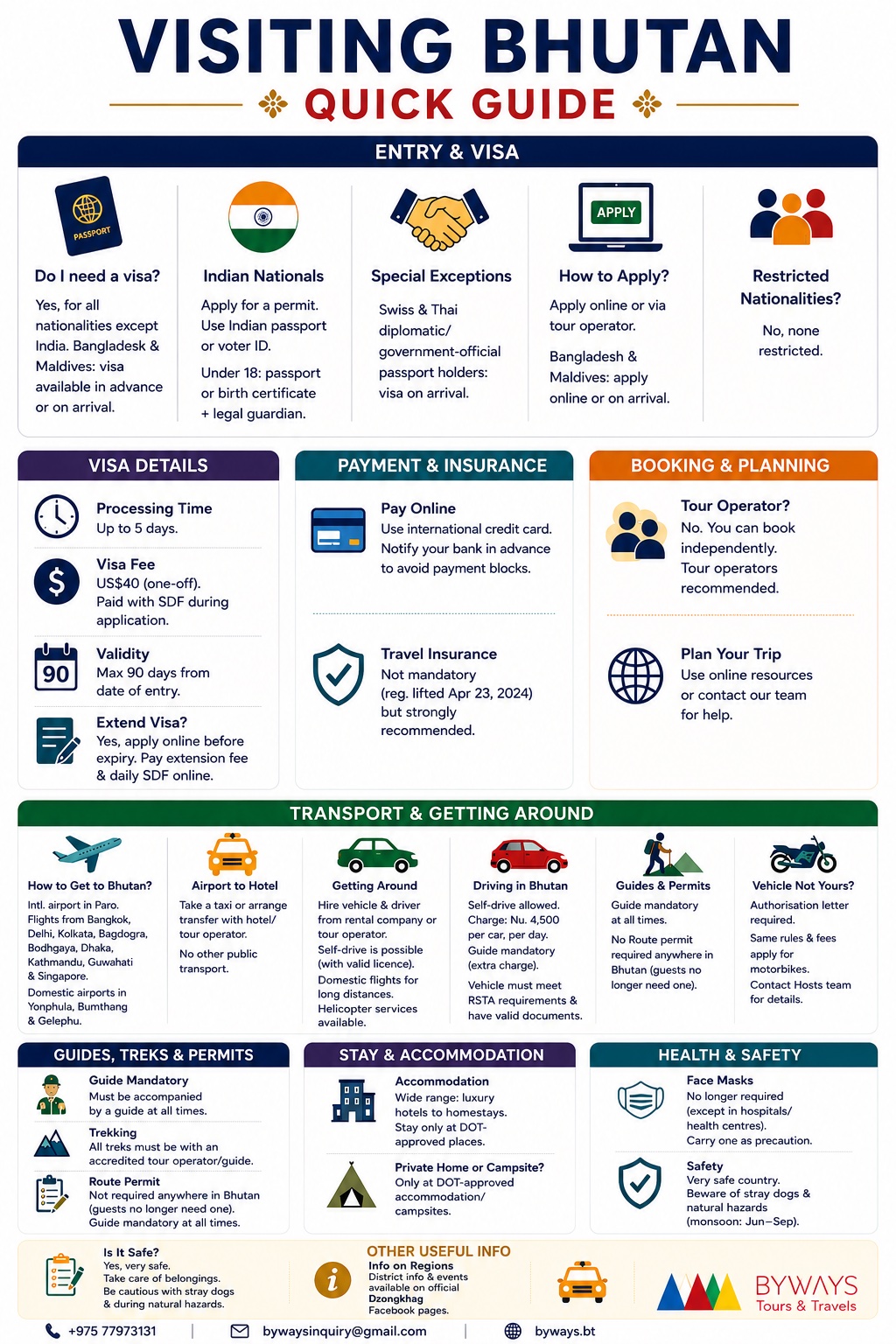
Infographic: Visiting Bhutan: Quick Guide — The complete overview at a glance — entry and visa rules, payment and insurance, transport, guides, accommodation, and safety.
Visiting Bhutan: Quick Guide

One infographic covering the essentials of visiting Bhutan: all nationalities except India, Bangladesh and the Maldives need a visa in advance, a licensed guide is mandatory throughout your stay, and international flights arrive at Paro International Airport from Bangkok, Delhi, Kathmandu, Singapore and other regional hubs.

Key Facts

  • Visa required for all nationalities except India, Bangladesh and Maldives
  • Visa fee US$40 (one-off), processed in up to 5 working days
  • A licensed guide is mandatory at all times
  • Travel insurance recommended but no longer mandatory
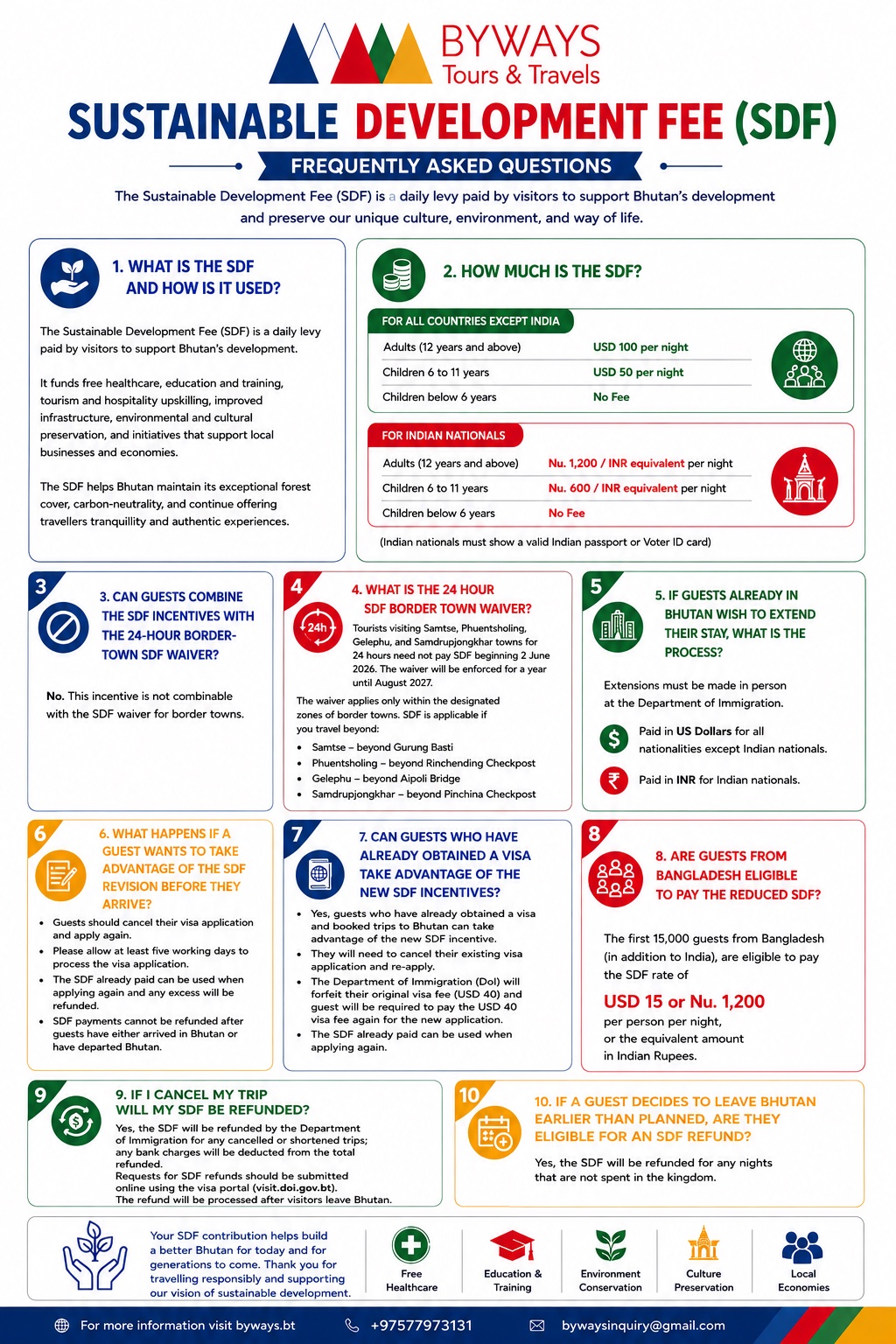
Infographic: Sustainable Development Fee (SDF) — How Bhutan's SDF works, current rates, who is exempt, and what the fee funds.
Sustainable Development Fee (SDF)

Bhutan's Sustainable Development Fee is a nightly levy that funds free healthcare, education, environmental conservation and cultural preservation. Adults pay US$100 per night (children 6–11 pay half, under-6s are free); Indian nationals pay Nu. 1,200 per night. Unused nights are refundable if you shorten your trip.

Key Facts

  • US$100 per adult per night (US$50 for children 6–11, under 6 free)
  • Indian nationals: Nu. 1,200 per adult per night
  • First 15,000 guests from Bangladesh: US$15 or Nu. 1,200 per night
  • Refunded for nights not spent in Bhutan

Visa & Entry

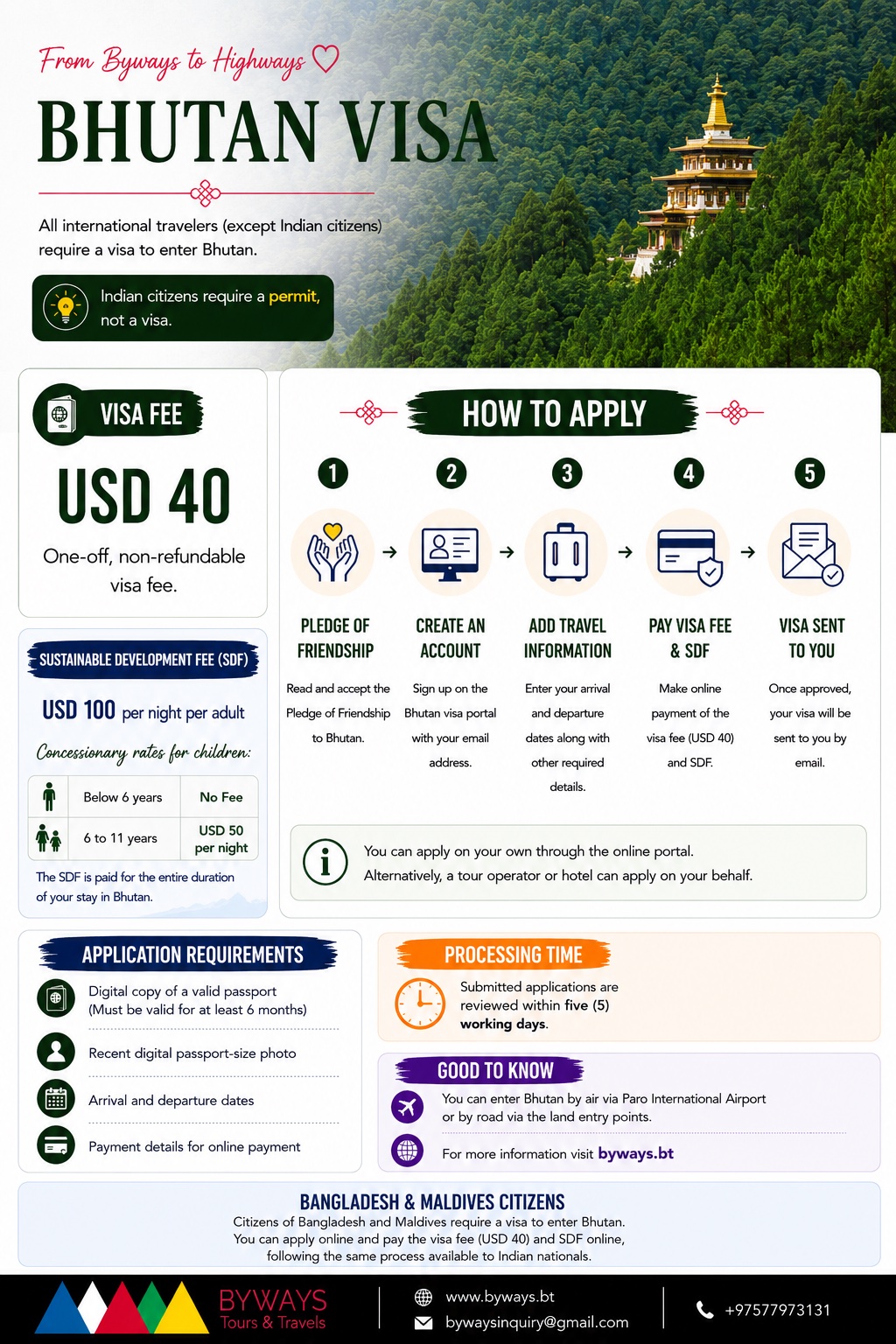
Infographic: Visa Application Process — Step-by-step walkthrough of applying for a Bhutan visa, from documents to approval.
Visa Application Process

Applying for a Bhutan visa takes five steps on the official portal: accept the Pledge of Friendship, create an account, add your travel details, pay the US$40 visa fee plus SDF, and receive your visa by email. Applications are reviewed within five working days, and a tour operator or hotel can apply on your behalf.

Key Facts

  • Visa fee: US$40, one-off and non-refundable
  • Processing time: within 5 working days
  • Apply yourself online or through a tour operator
  • Indian citizens need a permit, not a visa
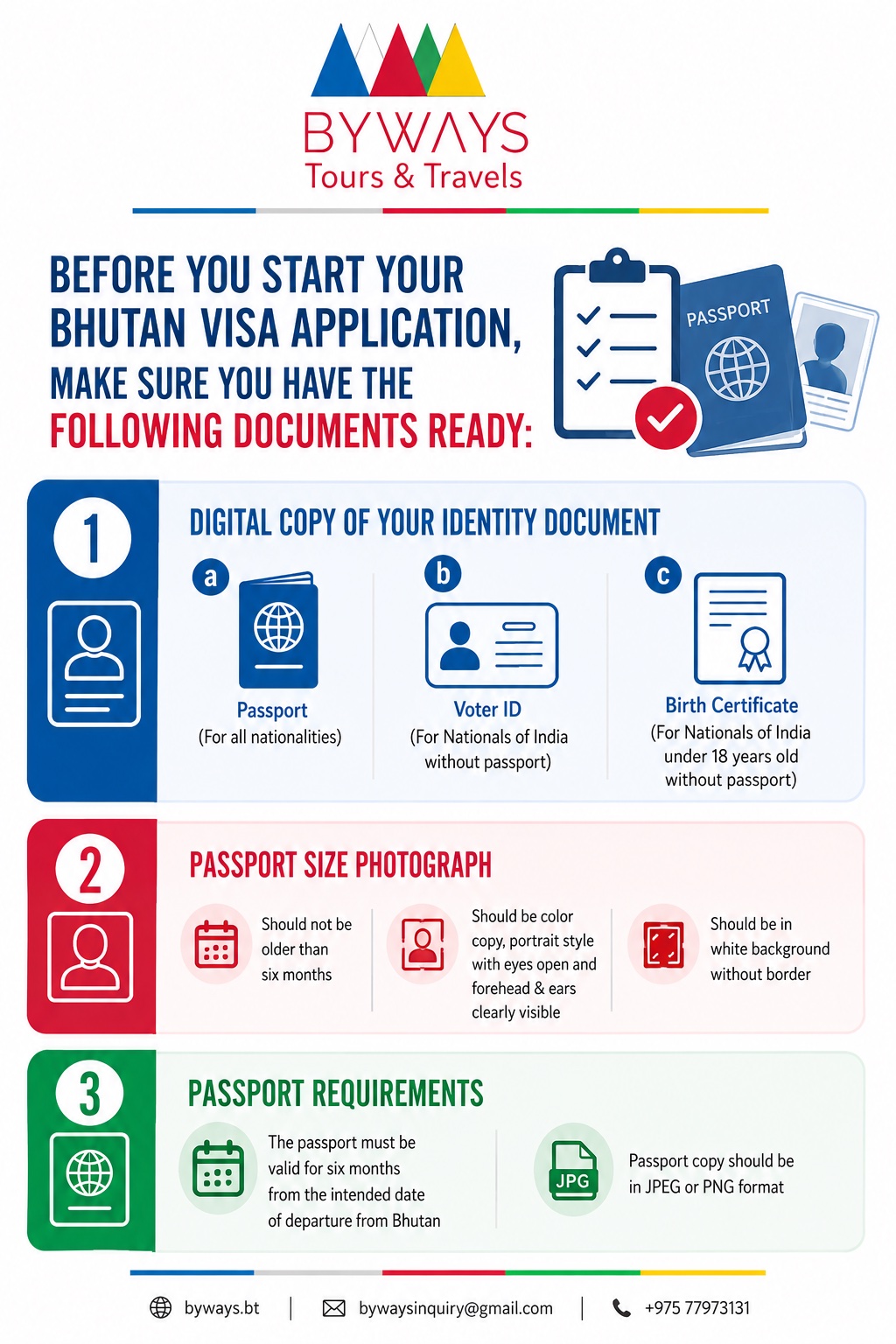
Infographic: Visa Document Checklist — Every document you need ready before you apply for your Bhutan visa.
Visa Document Checklist

Before starting your Bhutan visa application, prepare a digital copy of your passport (valid at least six months from your departure date), a recent color passport photo on a white background taken within the last six months, your arrival and departure dates, and payment details. Indian nationals can use a Voter ID instead of a passport.

Key Facts

  • Passport must be valid 6+ months from departure date
  • Passport photo: under 6 months old, color, white background
  • Files accepted in JPEG or PNG format
  • Indian nationals: Voter ID accepted; birth certificate for under-18s

Getting There

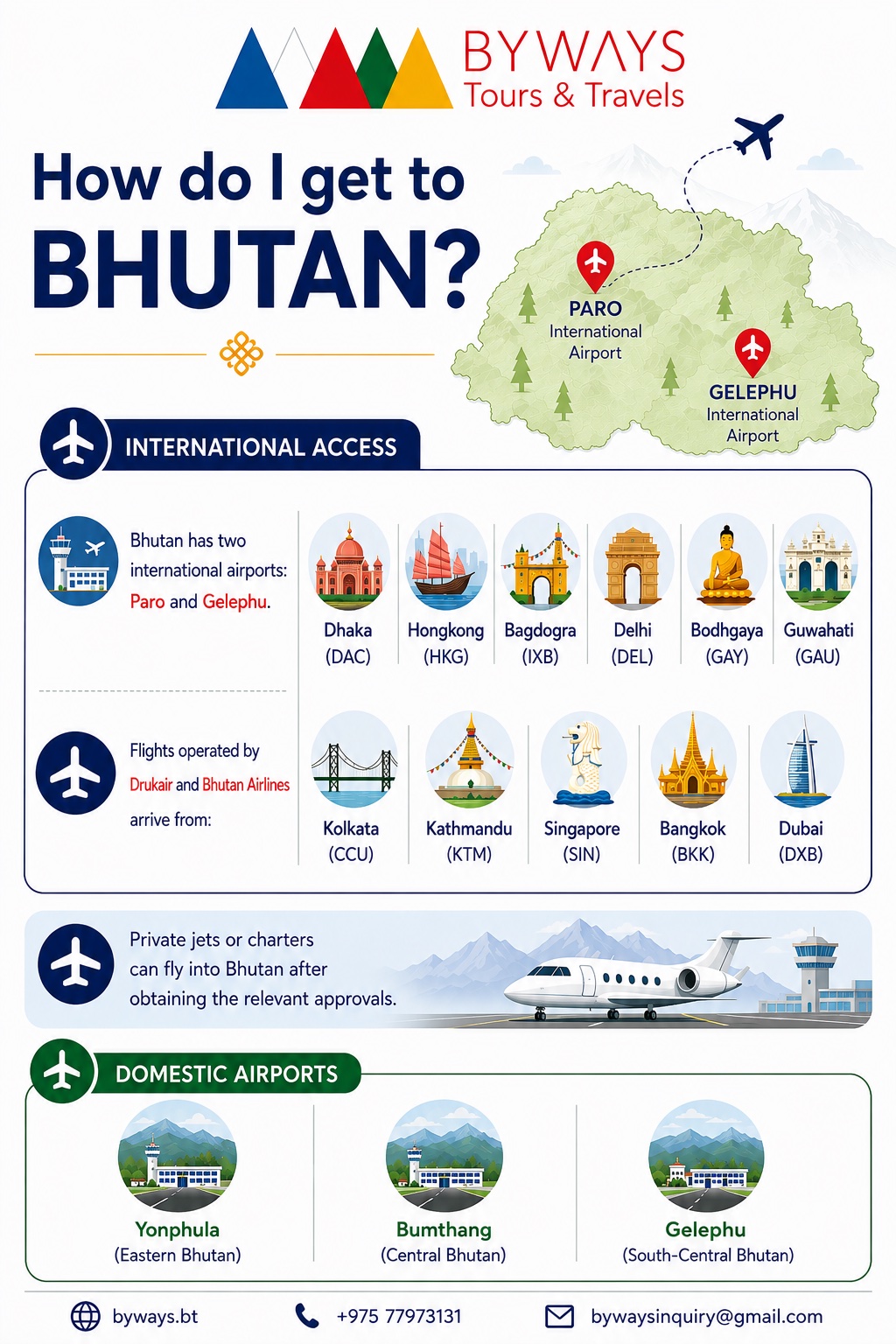
Infographic: How to Reach Bhutan — Flight routes into Bhutan's international airports and domestic connections.
How to Reach Bhutan

Bhutan has two international airports — Paro and Gelephu — served by Drukair and Bhutan Airlines with flights from Bangkok, Delhi, Kathmandu, Singapore, Dhaka, Kolkata, Bagdogra, Bodhgaya, Guwahati, Hong Kong and Dubai. Domestic airports at Yonphula, Bumthang and Gelephu connect the east, center and south of the country, and private charters can fly in with prior approval.

Key Facts

  • Two international airports: Paro and Gelephu
  • Airlines: Drukair and Bhutan Airlines
  • 11 departure cities including Bangkok, Delhi, Kathmandu and Singapore
  • Domestic airports: Yonphula, Bumthang and Gelephu
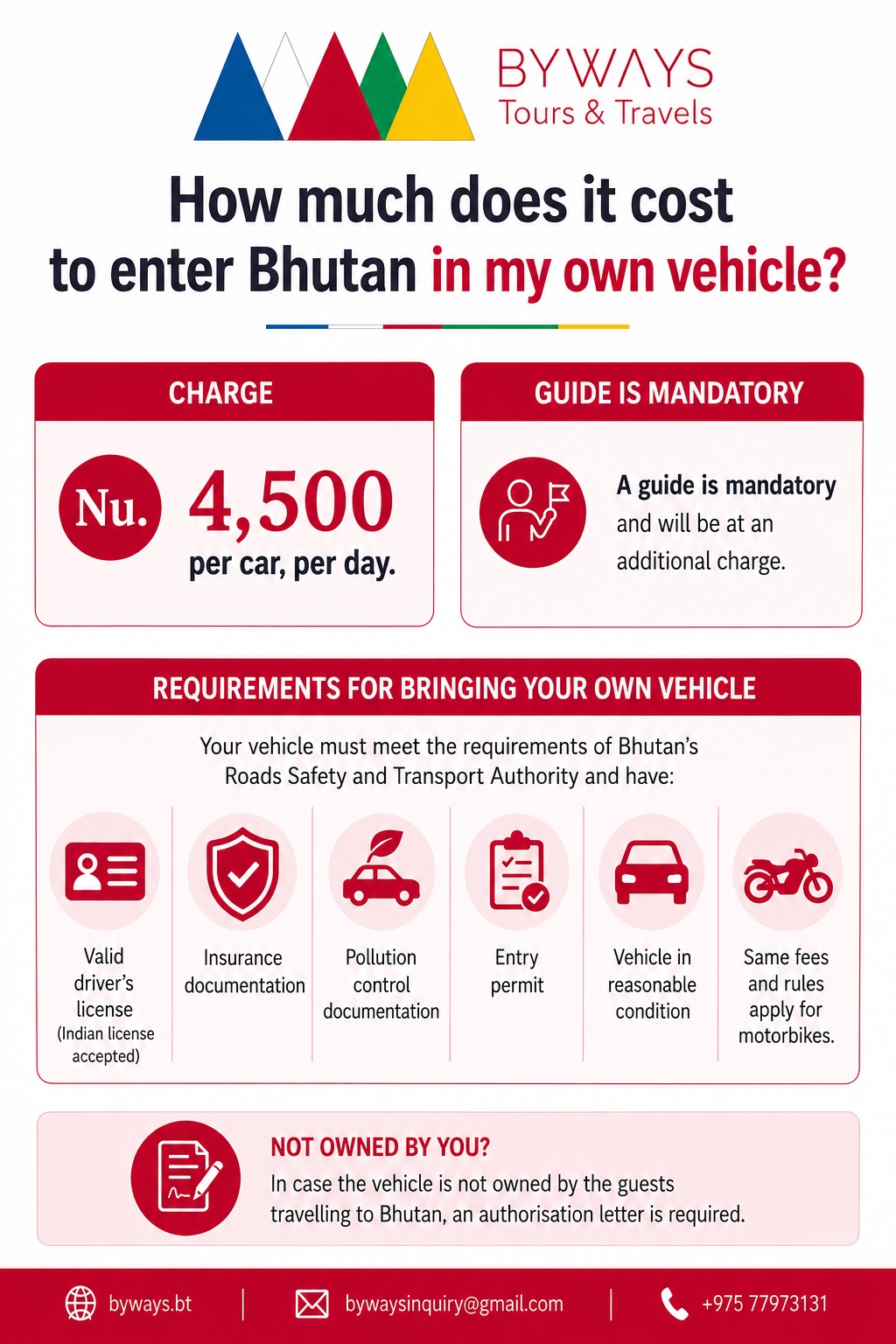
Infographic: Driving Into Bhutan: Vehicle Entry — Bringing your own vehicle or motorbike — permits, fees, and rules for self-drive entry.
Driving Into Bhutan: Vehicle Entry

You can drive your own car or motorbike into Bhutan for Nu. 4,500 per vehicle per day, with a licensed guide mandatory at extra charge. Your vehicle must meet Bhutan's Road Safety and Transport Authority requirements: a valid driver's license (Indian licenses accepted), insurance, pollution control documentation, an entry permit, and reasonable condition. An authorization letter is needed if the vehicle isn't yours.

Key Facts

  • Charge: Nu. 4,500 per car, per day
  • Guide mandatory (additional charge)
  • Requires license, insurance, pollution and entry permits
  • Same fees and rules apply to motorbikes

On the Ground

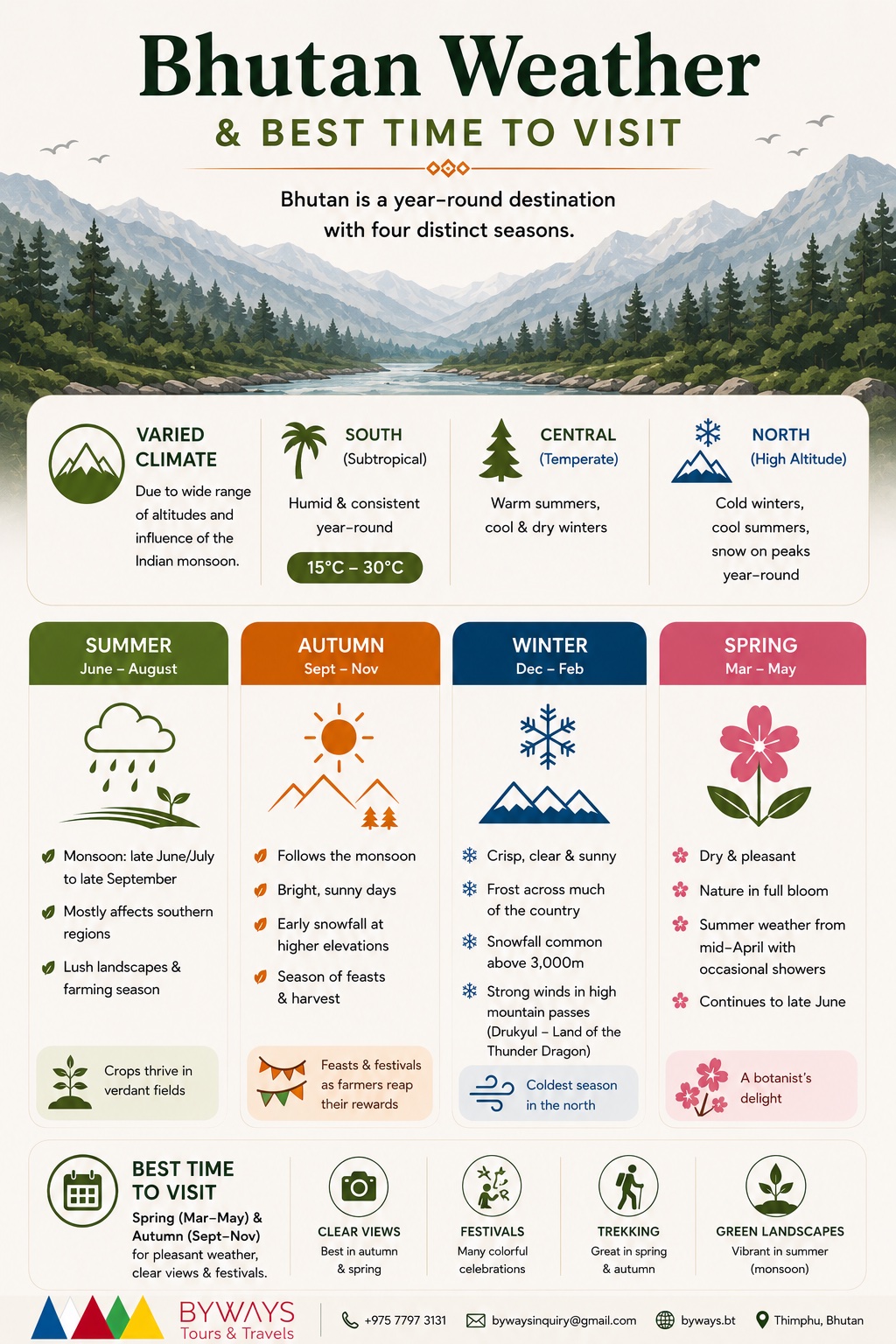
Infographic: Weather & Best Time to Visit — Season-by-season weather across Bhutan so you can pick the right months for your trip.
Weather & Best Time to Visit

Bhutan is a year-round destination with four distinct seasons. Spring (March–May) and autumn (September–November) are the best times to visit for clear views, festivals and trekking. The monsoon runs from late June to late September and mostly affects the south, while winters are crisp and sunny with snowfall above 3,000m.

Key Facts

  • Best time to visit: spring (Mar–May) and autumn (Sep–Nov)
  • Monsoon: late June to late September, mostly in the south
  • Winter: crisp and clear, snow above 3,000m
  • Climate varies sharply with altitude, 15–30°C in the subtropical south
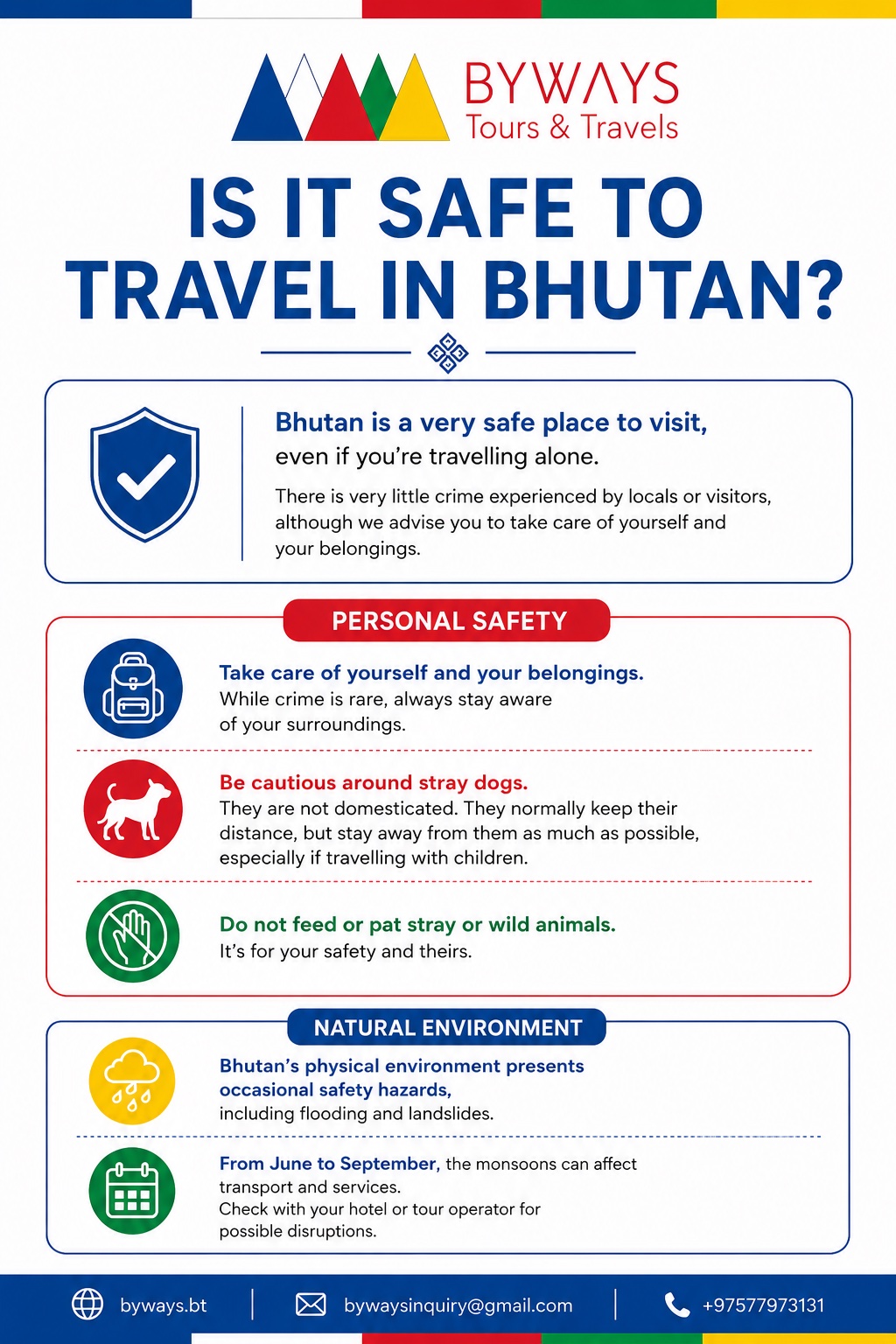
Infographic: Travel Safety Guide — How safe Bhutan is for travelers, plus practical precautions for your trip.
Travel Safety Guide

Bhutan is a very safe place to visit, even traveling alone — crime affecting visitors is rare. Sensible precautions: keep an eye on your belongings, keep your distance from stray dogs (especially with children), and don't feed or pet stray or wild animals. From June to September, monsoon flooding and landslides can occasionally affect transport, so check with your hotel or tour operator.

Key Facts

  • Very low crime — safe for solo travelers
  • Keep distance from stray dogs; don't feed wild animals
  • Monsoon (Jun–Sep) can disrupt transport and services
  • Occasional natural hazards: flooding and landslides
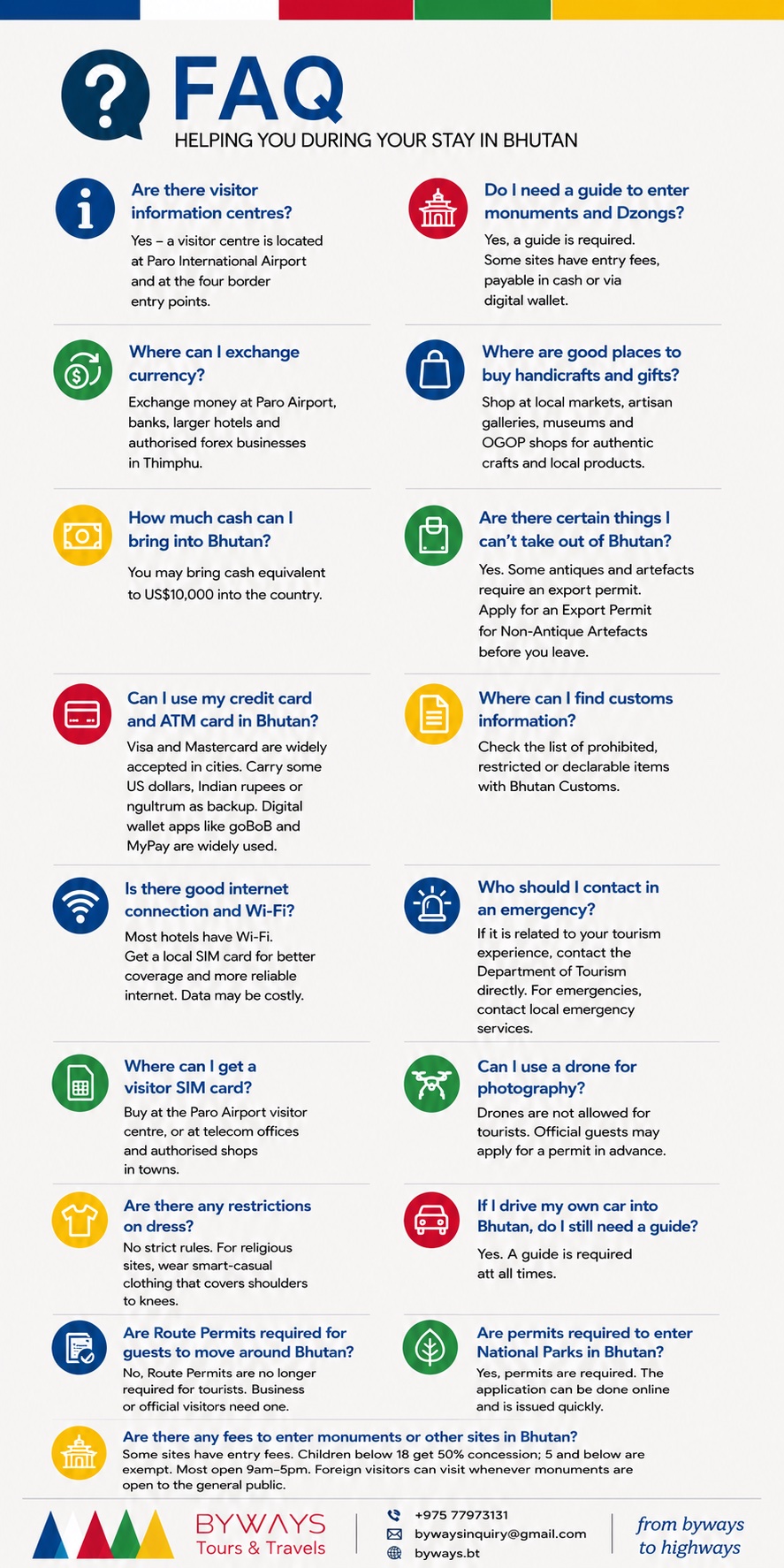
Infographic: FAQs During Your Stay — Quick answers to the questions travelers ask most while they are in Bhutan.

FAQs During Your Stay

Practical answers for while you're in Bhutan: exchange currency at Paro Airport, banks and authorized forex offices; Visa and Mastercard work in cities but carry backup cash (you can bring up to US$10,000); buy a local SIM at the Paro Airport visitor centre; dress modestly at religious sites; drones are not allowed for tourists; and route permits are no longer required to travel around the country.

Key Facts

  • Cash limit: up to US$10,000 equivalent may be brought in
  • Visa & Mastercard accepted in cities; local SIMs at Paro Airport
  • Drones not permitted for tourists
  • Route permits no longer required for tourists

Ready to Plan the Details?

Our written guides go deeper on every topic above — or talk to our local team and let us plan it for you.

WhatsApp